
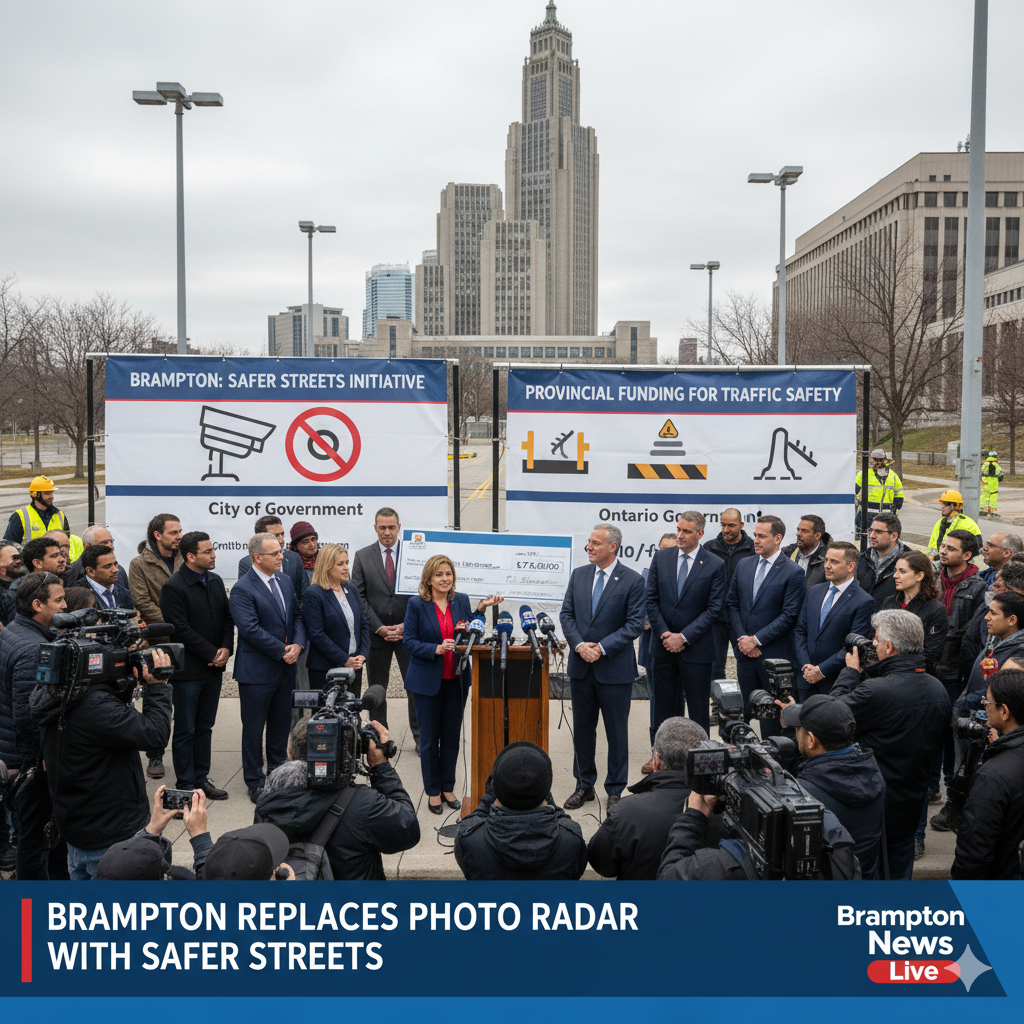

Brampton Receives Nearly $7 Million from Ontario Government to Replace Photo Radar Cameras with Traffic Safety Measures
The City of Brampton will receive close to $7 million from the provincial government to replace 185 decommissioned photo radar cameras with alternative traffic safety measures, following Ontario’s recent legislative changes. The funding, announced after the passage of Bill 56, is intended to support the city in implementing more traditional road safety initiatives, including signage, speed bumps, and other traffic-calming interventions.
Provincial Changes Prompt Funding Support
In early November, Ontario’s Bill 56 received royal assent, effectively banning municipal use of automated speed enforcement (ASE) cameras across the province. The legislation marked a significant policy shift, as municipalities had previously been permitted to operate speed cameras in community safety zones, a measure first authorized in 2019.
Ontario Premier Doug Ford framed the move as a response to concerns over the effectiveness and fairness of ASE cameras, labeling them as a potential “municipal cash grab.” Alongside the ban, Ford committed to providing municipalities with provincial funding to offset the costs of replacing the cameras with conventional traffic-calming solutions.
Brampton’s ASE Program: A Local Perspective
Brampton was among the earliest adopters of ASE technology in Ontario. Following the provincial approval in 2019, the city invested heavily in speed enforcement cameras within school and community safety zones. The city even opened a dedicated ticket processing centre in 2024 to handle the growing volume of automated traffic fines.
According to city officials, the provincial government has allocated immediate access to $6,997,000 through the fund established under Bill 56. This funding is intended to support the city in transitioning from automated cameras to alternative measures aimed at maintaining road safety.
Council Response to Provincial Funding
During the Nov. 26 general committee meeting, Councillor Michael Palleschi, representing Wards 2 and 6, acknowledged that while the provincial funding is a welcome start, additional resources will likely be required to fully replace the city’s ASE infrastructure.
The committee approved a staff recommendation to use $1.5 million of the $6.9 million allocation for initial planning and early implementation of alternative traffic-calming measures, prioritizing school zones.
“A lot of work has to be done, but we need to look at the number of schools in Brampton and start somewhere,” Palleschi said. “We can use the $1.5 million now, then allocate the remaining funds to fully understand the true cost and send the province the remainder of the bill.”
Effectiveness of ASE Cameras
City staff emphasized the effectiveness of ASE cameras in improving road safety. Data collected by the cameras demonstrated substantial reductions in speeding across Brampton, particularly in school and community safety zones.
“The loss of ASE as an automated deterrent is expected to result in a return to increased speeds within community safety zones, reversing several of the safety gains achieved through the program,” staff reported. They noted that while the cameras are no longer authorized for enforcement, many continue to monitor traffic for data collection purposes.
According to municipal data, ASE cameras contributed to a reduction in average vehicle speeds by 9.3 km/h across all monitored locations. Compliance with speed limits increased by an average of 38%, with some locations reporting reductions exceeding 20 km/h and sustained compliance rates above 90%.
Concerns Over Road Safety
City officials have expressed concern that the removal of automated speed enforcement may result in higher rates of speeding in critical zones. “ASE delivered measurable road safety improvements across Brampton,” the city’s report concluded.
Despite the evidence provided by Brampton, Premier Ford maintained that municipal speed cameras were ineffective in deterring speeding. The province’s position contrasted with Brampton’s data-driven approach, highlighting the ongoing debate between automated enforcement and traditional traffic measures.
Moving Forward: Brampton’s Road Safety Strategy
Mayor Patrick Brown stressed that the city must move forward in prioritizing road safety, despite the provincial ban.
“We can’t go backwards; we can only move forward. While we advocated for speed cameras as a life-saving initiative, we now need to explore other cost-effective traffic-calming measures,” Brown said during the committee meeting.
Early Implementation Plans
The city has already begun receiving new signage from the province, which will be installed in school zones as part of the funding conditions. Mayor Brown emphasized that the nearly $7 million in funding is only an initial allocation. Brampton will be able to apply for additional funds for other road safety initiatives beyond the initial support.
“There are two funding streams,” Brown explained. “The first is the $6.9 million to get started, and the second is an additional fund for any other innovative ideas we propose.”
Alternative Uses for Existing Infrastructure
Although ASE cameras can no longer be used to issue speeding tickets, the city is exploring other applications for the technology. This includes installing additional red-light cameras and using existing units to detect vehicles with modified or excessively noisy exhaust systems, in violation of municipal noise bylaws. Mayor Brown confirmed that the province has approved these alternative uses.
Financial Considerations
Implementing alternative traffic-calming measures such as speed bumps, signage, and roundabouts comes with significant costs. City officials have noted that equipping every school zone with full signage or constructing new roundabouts is a financially demanding endeavor. Nonetheless, the city is committed to maximizing the impact of provincial funding while ensuring public safety.
Collaboration with Provincial Authorities
Brampton officials have indicated that ongoing discussions with the provincial Ministry of Transportation aim to identify practical and cost-effective solutions. “We’re having very collaborative conversations with the minister’s office on how we proceed,” Mayor Brown said.
Conclusion
Brampton’s road safety landscape is undergoing a significant transformation following the provincial ban on ASE cameras. With nearly $7 million in funding, the city is poised to implement a combination of signage, speed bumps, and other traffic-calming measures, focusing initially on school zones.
While challenges remain, including the high cost of alternative infrastructure and the potential for increased speeding, city leaders are committed to maintaining and improving road safety. Brampton’s approach underscores the importance of data-driven planning and collaboration with provincial authorities to ensure that public safety remains a priority in the wake of legislative changes.
As Brampton moves forward, the city will continue to explore innovative strategies to protect residents, adapting to new provincial regulations while building on the success of its former ASE program.