
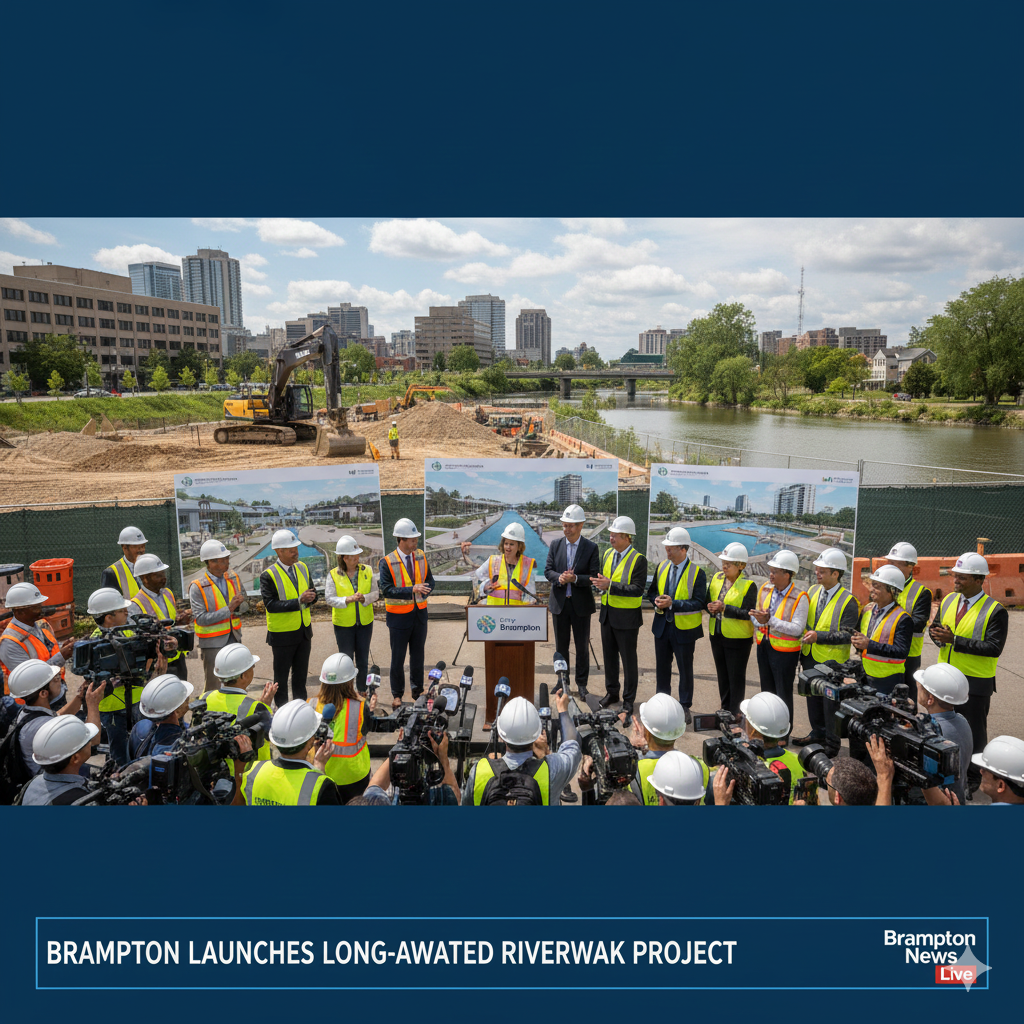

Brampton Launches Long-Awaited Riverwalk Flood Mitigation Project to Transform Downtown
Brampton has officially broken ground on a landmark downtown flood mitigation initiative, nearly 14 years after the project was first proposed. The Riverwalk project aims to provide enhanced protection against flooding while unlocking development opportunities in the city’s floodplain-designated downtown core.
Mayor Patrick Brown, alongside local officials, marked the official start of construction at a ceremonial groundbreaking on November 21, emphasizing the project’s transformative potential for Brampton’s urban landscape.
Addressing Downtown’s Floodplain Challenges
Brampton’s downtown area sits within a provincially regulated floodplain, formally designated as a Special Policy Area (SPA). This designation, while acknowledging the area’s regulatory constraints, also recognizes the downtown core as the city’s economic and civic heart, meriting careful investment and development.
According to the city, Riverwalk is a “once-in-a-generation” infrastructure project that will not only mitigate flooding risks but also enable sustainable urban growth. “Feasibility studies have shown that it is possible to eliminate the flood hazard, which would, in turn, allow for the removal of the SPA designation,” city officials noted.
Historical Flooding in Brampton
Although major flooding incidents in downtown Brampton have been rare for decades, the region has a long history of flood challenges. The catastrophic flood of March 1948 led to the diversion of the Etobicoke Creek via a concrete channel in 1952, protecting the downtown core from future overflow.
“While this channel has safeguarded the area from flooding, strict provincial regulations still limit development in the downtown,” the city explained. Riverwalk aims to modernize this protection system, reducing the risk of flooding during extreme storms and providing comprehensive safeguards for residents and businesses alike.
Project Goals and Urban Benefits
The Riverwalk project is designed to achieve multiple objectives:
-
Enhanced Flood Protection: Deepening and widening the Etobicoke Creek diversion channel to manage extreme rainfall and storm events.
-
Urban Development: Removing regulatory constraints to allow residential and commercial growth within downtown Brampton.
-
Public Spaces and Recreation: Creating parks, greenways, and trails to provide residents with access to nature and vibrant communal areas.
Mayor Brown emphasized the project’s broader impact: “The Riverwalk Flood Protection Project is a once-in-a-generation investment that will protect our community, unlock our downtown’s full potential, and help drive new housing, jobs, and economic growth.”
From Planning to Implementation
The Riverwalk initiative was first proposed under former Mayor Susan Fennel in January 2011. Between 2013 and 2018, the city, in collaboration with the Toronto and Region Conservation Authority (TRCA), conducted provincial and federally funded feasibility studies to assess the technical and environmental requirements of the project.
In 2014, the provincial government approved an SPA amendment permitting limited revitalization and redevelopment across approximately 30 hectares of downtown Brampton. However, full-scale development remained constrained until a comprehensive flood mitigation strategy could be implemented.
Phase 1: Flood Infrastructure Construction
The first phase of Riverwalk focuses on strengthening flood defenses by modifying the Etobicoke Creek diversion channel. City engineers will deepen and widen the channel, enhancing its capacity to handle high water volumes during severe weather events.
This phase prioritizes safety and infrastructure resilience, forming the foundation for subsequent development and public space initiatives.
Phase 2: Parks, Housing, and Commercial Development
While no official timeline has been released for the second phase, the city anticipates it will focus on creating vibrant urban spaces. Planned features include:
-
New parks and green spaces
-
Walking and cycling trails
-
Residential housing projects
-
Commercial and retail developments
By integrating flood protection with urban revitalization, Riverwalk is expected to transform downtown Brampton into a safer, more attractive, and economically dynamic hub.
Funding and Partnerships
Riverwalk is backed by significant federal and provincial investment, totaling nearly $90 million.
-
Federal Contribution: $38.8 million through Canada’s Disaster Mitigation and Adaptation Fund.
-
Provincial Contribution: Nearly $50 million from Ontario’s Municipal Housing Infrastructure Program.
Mayor Brown expressed gratitude for the multi-level governmental support. “This project will safeguard Brampton from flooding and will welcome thousands of new residents and businesses into a vibrant reimagined downtown. We are grateful to our partners in the governments of Canada and Ontario, and the Toronto and Region Conservation Authority, for their collaboration and investment in Brampton’s future.”
Collaboration with Conservation Authorities
The Toronto and Region Conservation Authority (TRCA) continues to play a critical role, providing technical expertise and environmental oversight. This partnership ensures that Riverwalk’s design meets stringent safety, ecological, and sustainability standards while enhancing community access to natural spaces.
Economic and Social Impacts
Riverwalk is not merely a flood mitigation initiative—it represents a strategic urban renewal effort. By reducing the risk of flooding and lifting provincial restrictions on development, the project is expected to:
-
Attract private investment and development
-
Increase downtown housing options
-
Create new jobs in construction, retail, and services
-
Enhance public amenities and recreational opportunities
City planners note that integrating green infrastructure and recreational spaces will also improve the quality of life for residents, creating a downtown that balances growth with environmental stewardship.
A Long-Awaited Investment
Mayor Brown characterized Riverwalk as a generational investment in Brampton’s future. “This is more than infrastructure; it’s about shaping the city for the next decades. We are creating a safer, more vibrant downtown that will serve residents, businesses, and visitors for generations to come.”
The project’s phased approach allows Brampton to simultaneously address flood mitigation while planning for long-term urban growth, ensuring that the downtown core remains both safe and economically viable.
Looking Ahead
With construction underway, Brampton is poised to witness a transformation in its urban landscape. Riverwalk is expected to become a model for integrating environmental resilience with urban planning, demonstrating how flood mitigation projects can serve as catalysts for economic development and community revitalization.
As the city moves forward, continued collaboration with provincial and federal partners, combined with strategic urban planning, will be crucial in realizing Riverwalk’s full potential. By safeguarding the downtown from flooding and creating new development opportunities, Brampton is laying the groundwork for a thriving, resilient, and dynamic city core.