
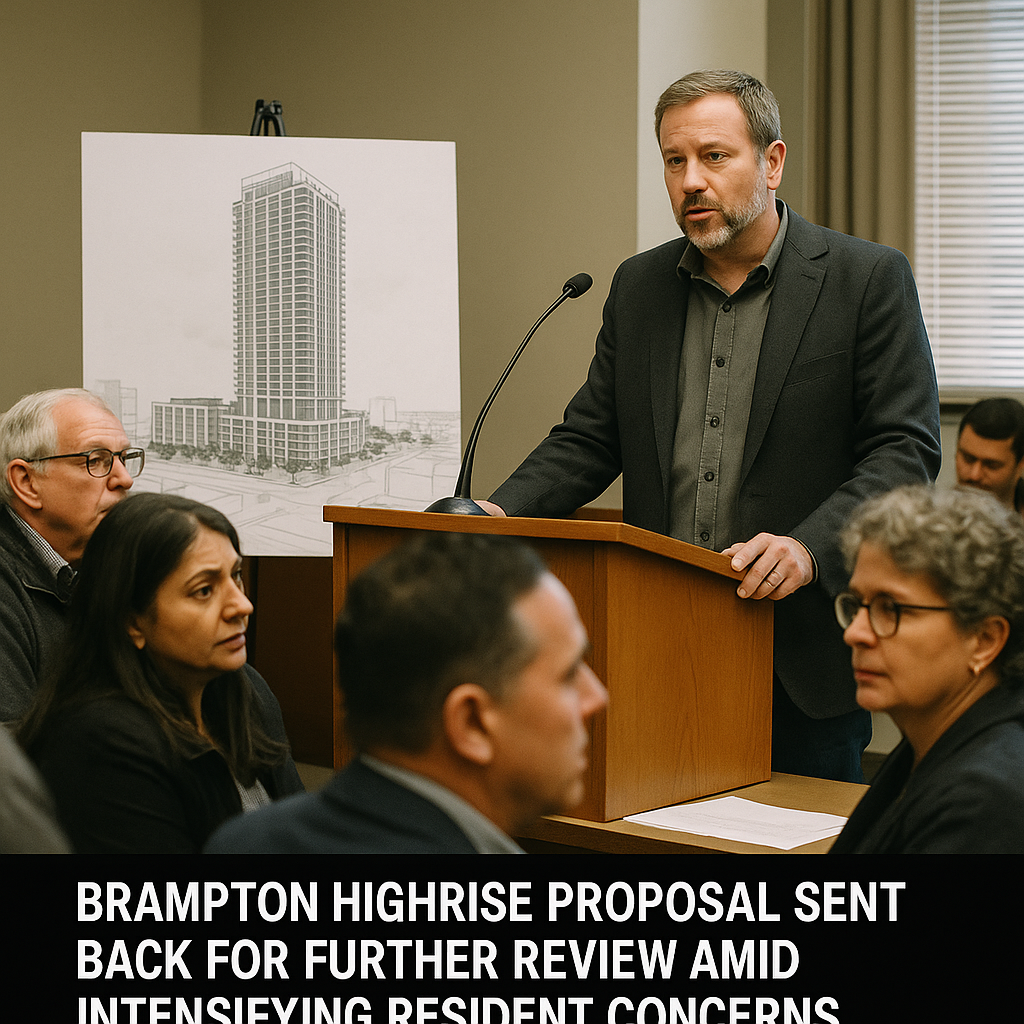

Brampton Highrise Proposal Sent Back for Further Review Amid Intensifying Resident Concerns
Introduction: A Routine Application That Became Anything But
A seemingly straightforward planning application in Brampton’s west end has taken an unexpected detour. What began as a proposal to transform a vacant commercial site into an eight-storey mixed-use development has become a focal point for neighborhood concerns, political scrutiny, and a renewed push for community engagement.
At the heart of the matter is a project slated for 1453 Queen Street West—an address sitting near Creditview Road and poised, according to city staff, to support Brampton’s long-term ambitions for transit-oriented intensification. Yet the project’s momentum hit a pause button when local councillors, echoing residents’ unease, referred the application back to staff for reconsideration.
In moments like these, one can almost hear the dry humor of Mark Twain reminding us that “progress has its drawbacks.” And for many residents, the proposed building height, backyard visibility, and traffic implications felt like drawbacks worth discussing—again.
Background: A Development Aimed at Growth
What Was Proposed
The application before council sought amendments to the official plan and zoning bylaw to allow an eight-storey building combining housing, commercial uses, and office space. The development, submitted by Glen Schnarr and Associates Inc. on behalf of Fateh Developments Inc., envisioned 94 residential units occupying the upper floors.
According to the city staff report, ground-floor plans included 400 square metres of retail space, while 973 square metres of office space would be distributed across the first and second floors. The project was positioned as a blend of housing and employment uses—key ingredients in Brampton’s strategy to promote complete communities.
The 0.69-hectare site, currently home to a one-storey vacant commercial building, seemed ripe for redevelopment. Staff emphasized that the proposal aligned with Queen Street’s transit corridor vision, noting it would encourage density, support local businesses, and make efficient use of existing infrastructure.
A Fictional Glimpse: One Resident’s Perspective
A longtime resident, Maria Singh, recalls driving past the vacant structure for years. “It looked like a forgotten shoebox,” she joked while speaking to neighbors at a community meeting. She admitted she wasn’t opposed to change—after all, cities evolve. But Maria wondered whether the shadow of a new eight-storey neighbour would loom a little too literally over nearby backyards. Her remarks sparked knowing nods from others who shared similar questions.
Her comment, half lighthearted and half sincere, underscored the delicate balance between growth and neighborhood comfort. It also demonstrated why intensified consultation felt necessary.
The Turning Point at Council
Concerns Amplified at the Committee Meeting
When the planning and development committee convened on December 1, it became clear that residents’ earlier concerns had not dissipated. Councillors Dennis Keenan and Martin Medeiros, who represent Wards 3 and 4, voiced apprehension that constituents still felt unheard.
Keenan explained that several residents had expressed frustration that their “questions or concerns were not answered.” Medeiros echoed the sentiment, noting worries about visibility from the proposed building into neighboring yards, a recurring theme since the spring.
Both councillors acknowledged the thoroughness of staff’s technical review. Still, they argued that community comfort remained an essential factor in planning decisions. As Medeiros put it, more time was needed “to review it and communicate with our residents better.”
A Procedural Reset
With these remarks, the committee voted to refer the application back to city staff. This sends the project into a holding pattern while planning teams revisit the concerns, re-evaluate information, and prepare additional responses or revisions as needed.
The application will return to the planning committee at a later date—though no timeline has yet been set.
Resident Feedback: Height, Traffic, and Natural Systems
Issues Raised at the Public Meeting
A statutory public meeting held on April 7 offered one of the earliest windows into resident sentiment. Four attendees spoke, raising issues tied principally to building height, traffic pressures, and the safeguarding of the adjacent natural heritage system.
City staff also received two written submissions, one signed collectively by fifteen residents. Many worried that a building of this scale would alter sightlines and cast larger shadows than what the neighborhood was accustomed to. Others questioned whether local roads could handle increased traffic volumes, particularly during rush-hour windows when Queen Street already strains under commuter demands.
A Closer Look at Environmental Concerns
The site sits near natural heritage features, which triggered additional questions about ecological protection. Staff acknowledged these factors in their recommendation report and explained that the proposal included required buffers and mitigation measures to safeguard sensitive areas.
However, as any planner knows, the presence of protective measures does not automatically assure residents. Anecdotes shared at the meeting reflected fears—some practical, some emotional—that too much development too quickly could erode the character of the adjoining natural corridor.
One resident humorously remarked that the local rabbits “deserved consultation too,” a comment that earned a few laughs but served a more serious point: maintaining balance is vital.
Staff’s Position: A Project Aligned With City Goals
Supporting Housing and Transit Goals
The city staff report outlined several benefits of the development. It emphasized the proposal’s alignment with Brampton’s broader housing objectives, noting that adding 94 residential units could contribute meaningfully to supply in a high-demand market.
Staff also pointed to the Queen Street corridor as a key location for intensification due to its transit connections. Concentrating growth near transit is a strategy embraced across the Greater Toronto Area, one that aims to reduce car dependency and support public infrastructure more efficiently.
Mixed-Use Benefits
The inclusion of retail and office space was highlighted as another positive. Mixed-use buildings create daytime activity, diversify land use, and support a more dynamic and inclusive community fabric. In theory, this reduces the need for residents to travel far for everyday services—something planners celebrate as a “15-minute community” concept.
Infrastructure Compatibility
The staff report further emphasized that municipal systems—water, wastewater, and transportation—currently have the capacity to support the development. With infrastructure already in place, redevelopment can occur more sustainably and without extensive new servicing.
What Happens Next?
Awaiting Revised Analysis
With the motion for referral now confirmed, city staff will re-engage with the concerns raised, potentially adjusting their recommendations or providing deeper analysis. Developers may also revisit aspects of the project—particularly height, buffering, or design—to address community expectations.
This stage often determines the long-term trajectory of a proposal. Sometimes solutions emerge smoothly; other times, tensions remain. As comedian George Carlin once quipped, “Some people see things that are and ask why. Some people dream of things that never were and ask why not.” Planning often places these viewpoints in the same room.
Continued Resident Engagement
Public participation will continue to play a central role. Additional meetings, updated reports, and opportunities for written feedback will likely help refine the project’s next iteration. For residents, this represents another chance to influence the future of their neighborhood.
Conclusion: A Reminder That City-Building Is Collaborative
The temporary setback for the Queen Street West proposal demonstrates that redevelopment is rarely a linear process. Despite meeting many technical planning expectations, the project must also satisfy community comfort and address the lived experiences of residents.
The outcome remains undecided, but the conversation has already yielded something valuable: a renewed commitment to transparency, engagement, and thoughtful growth. Brampton continues to evolve, and this moment serves as a small but meaningful reminder that city-building works best when residents, staff, and elected officials move forward together—even if they occasionally pause to ask a few more questions along the way.